
Incoterms
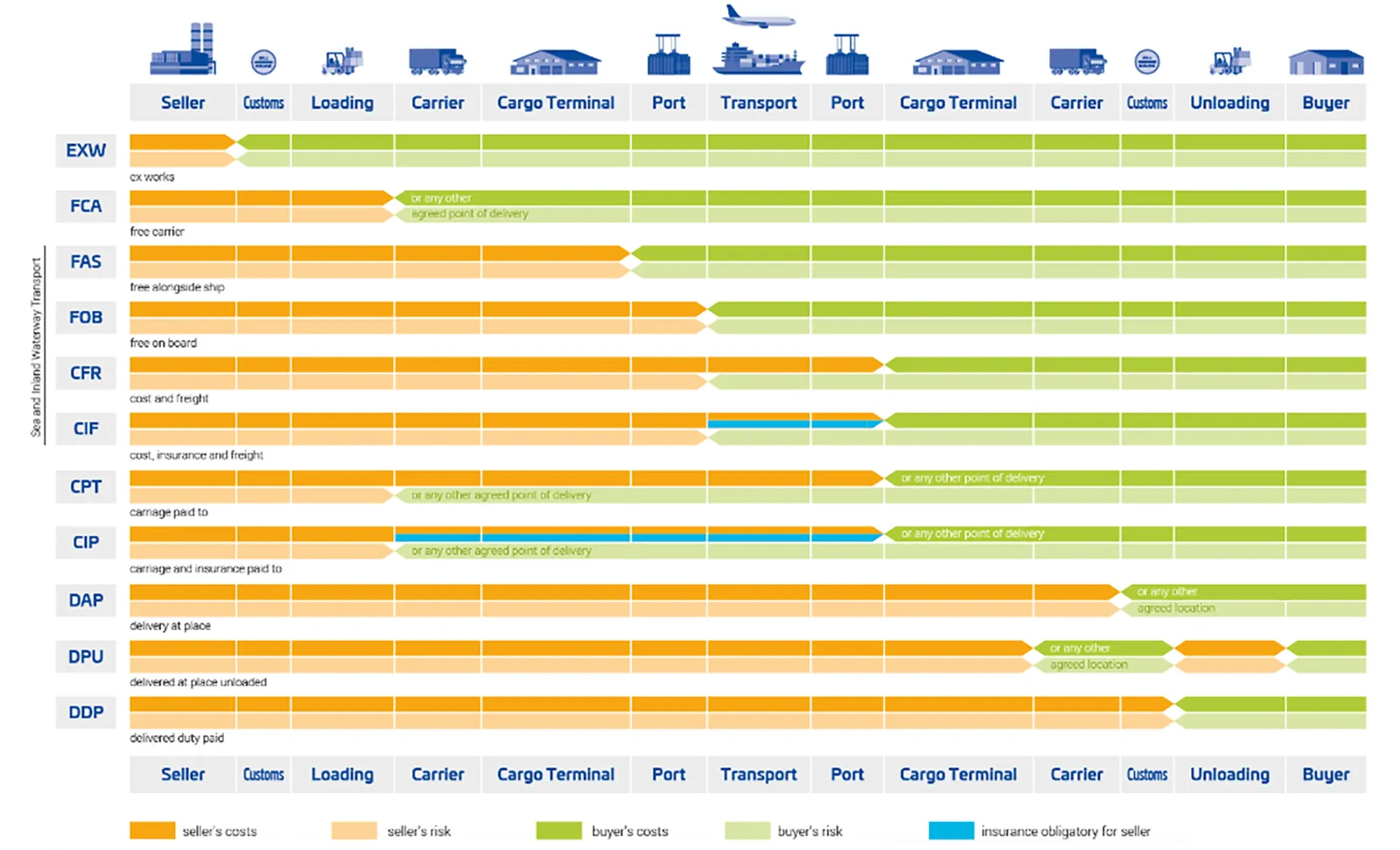
Incoterms are internationally recognized rules that define the responsibilities of sellers and buyers in an export transaction. Here is a short overview of the latest Incoterms, put in place in 2020. (So 2020 Incoterms) When doing international business, understanding and choosing the right Incoterm is really crucial.
EXW — Ex - works
With Ex Works, the sole responsibility for the entire shipment lies with the buyer. Basically , the buyer has bought their goods and needs to arrange transport of their goods from the factory or designated place of origin. Both the risk and the costs for the entire transport are for the account of the buyer. Even though this is a frequently requested Incoterm, it is not the Incoterm that we would recommend. The fact that the buyer is responsible for customs in the country of origin, exposes them to all kinds of additional risks, which can easily be avoided by buying the goods on FCA -place of loading- basis.
FCA — Free carrier
With the Free Carrier Incoterm, there are two extra responsibilities for the seller, compared to EXW. The seller will have the obligation to handle customs at origin, and to do the loading of the goods. As soon as the cargo is loaded on the truck or container, the responsibility for the seller ends. The rest of the journey is both at cost as well as the risk of the buyer. The fact that the customs declaration is done by the seller makes a crucial difference compared to the EXW Incoterm mentioned earlier. This Incoterm is considered more favorable for both parties.
FAS — Free alongside ship
This Incoterm is not often used nowadays. It means that the seller has the responsibility of delivering the cargo "alongside the ship". While this is workable for break-bulk cargo, for containerized cargo it doesn't work as well. Containers are delivered at a terminal, and not alongside a ship. For containers delivered at terminal it is better to use the Incoterm FCA, specifying the collection point as "port terminal", or FOB - Free on Board.
FOB — Free on board
Together with the EXW Incoterm , FOB is probably the most commonly requested Incoterm. Here too, FCA "Port terminal" is the better option. For FOB shipments the responsibility and the costs transfer from seller to buyer as soon as the container is loaded on board of the vessel. The reason we recommend FCA over FOB, has to do with the transference of the cargo, which is better suited to a "place of" description, than once it passes the ship rail.
CFR — Cost and freight
This is the first Incoterm where the seller pays for the transport up to the destination port. While the seller is responsible for the costs, we cannot stress enough that the risk during the ocean voyage is for the buyer of the goods. So if anything should happen to the cargo during ocean transit, the buyer bears the cost.
CIF — Cost, insurance and freight
This is a very similar incoterm to the CFR one we just highlighted above. We stressed the fact that the risk for the transport of the goods on the vessel was for the buyer, but with the CIF incoterm it is obliged that the seller takes an insurance for the buyer at his expense. Take into account though that there is no specification on how good the insurance needs to be and that the contractual 'minimum' insurances do not cover the total cargo loss of the goods. Check out our possibilities to offer you a 110% covering insurance for your goods. Taking away your worries, that is our main goal!
CPT — Carriage paid to
With the Carriage Paid to Incoterm, the seller bears the expense of transport up to destination (air)port. However, as with CFR, the risk of the transport transfers a lot earlier. The risk may be transferred when goods are picked up at seller's premises, or at another specified place.
CIP — Carriage and insurance paid to
This is a very similar incoterm to the CPT one we just highlighted above. Again we stress the fact that the risk for the transport, transfers to the buyer before the costs do, but now with the CIP incoterm the seller is obligated to take an insurance for the buyer at his expense. Here too the Incoterm gives no instructions as to what type of insurance, so you might end up with limited liability coverage. At Embassy Freight we can offer you an all risk policy, with coverage for up to 110% of the commercial value of your goods.
DAP — Delivery at place
When using the Incoterm DAP in international trade, it means the seller bears the cost of transport from origin until the cargo arrives at your door. The unloading when cargo arrives at destination is for the buyer. The risk remains at shippers side until cargo arrives at destination. If during the stripping of the container the cargo is somehow damaged, this is the responsibility of the buyer. Custom clearance at destination is for the buyer as well.
DPU — Delivery at place unloaded
A very similar Incoterm to DAP. This was DAT - Delivered at terminal - in the previous version of the Incoterms (2010). This Incoterm is most frequently used when the buyer wants to take over both cost and risk at a pre-determined delivery place, most commonly the destination terminal.
DDP — Delivery duty paid
This is the incoterm with the most responsibilities and costs for the seller. The seller takes away all the worries, costs, risks and formalities from the buyer. the shipper is responsible for moving the cargo from their warehouse, all the way up to the final recipients door. They will even be in charge of the customs formalities in the country of the destination. Just as we do not promote the EXW incoterm, where the buyer needs to do the custom clearance in the country of his shipper, we're not big fans of the DDP incoterm, where those roles are reversed. We would strongly recommend the DAP incoterm, as we believe custom formalities are a local matter which are best done by the residents of that specific country.
Would you like to know more about us?
Follow us on LinkedIn.